
Wall tie failure in coastal North Tyneside homes
Cavity wall ties are the metal straps that hold the inner and outer leaves of a cavity wall together. In properties built from roughly the 1920s through to the early 1980s, those ties were usually mild steel with a galvanised coating. That coating has a working life, and once it goes the steel begins to rust.
Rust takes up more space than the metal it replaces, so as a tie corrodes it expands and lifts the mortar course it is bedded into. Multiply that across a whole elevation and the outer leaf is slowly jacked upwards. The result is the classic sign: regular horizontal cracking along mortar beds, often at roughly every sixth course, sometimes with bulging brickwork or lifted window heads alongside it.
Exposure is what drives the timescale, which is why coastal North Tyneside sees it earlier than inland stock. Properties in Tynemouth and Whitley Bay take driving rain and salt laden air straight off the North Sea, and salt accelerates corrosion considerably. West facing and seafront elevations tend to fail first while sheltered elevations on the same house stay sound.
What to look for is straightforward once you know. Stand back and look along the brickwork in low sunlight, when shadows show up cracking that is invisible head on. Horizontal cracks that follow the mortar rather than stepping diagonally through it are the giveaway, because stepped diagonal cracking usually points to movement or settlement instead. Bulging that you can see by sighting along the wall, and gaps opening around window frames, are later stage signs.
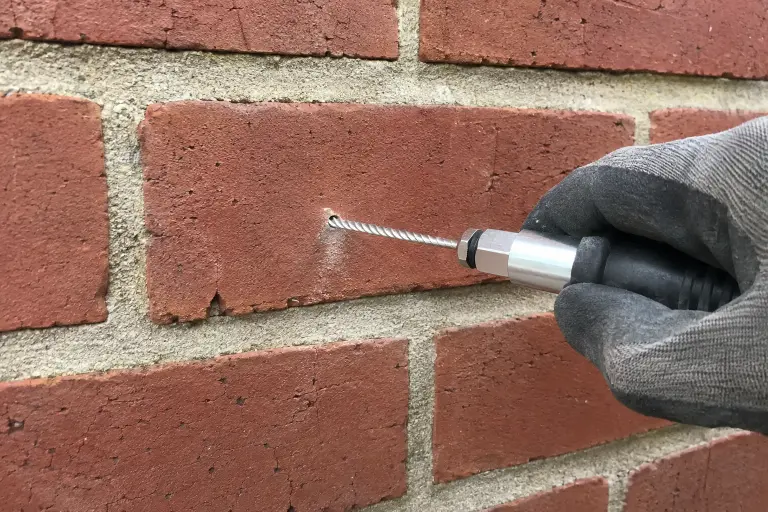
The survey itself is not destructive. A borescope goes into a small drilled hole so the existing ties can be inspected in the cavity, and we check enough positions across each elevation to judge the condition of the whole wall rather than one lucky spot. Where ties have failed, remedial ties are installed at calculated centres, the original ties are isolated where necessary and the drill holes are made good to match the existing mortar. The detail is on our wall tie replacement page.
It is worth dealing with early for two reasons. The first is structural: an outer leaf that is no longer tied to the inner leaf loses a good deal of its stability against wind loading, which matters on an exposed coastal elevation. The second is damp. Cracked mortar beds and open joints let water into the fabric, and that shows up inside as penetrating damp, which then needs damp proofing and replastering on top of the masonry repair.
Wall tie work also tends to surface during a sale. A buyer's surveyor who spots horizontal cracking will flag it, and lenders can hold up an offer until the cause is established. A written report and, where needed, a guaranteed remedial tie installation settles that quickly, and our guarantees are issued in the property owner's name and transfer to the new owner, as set out on our accreditations and guarantees page.
We survey and replace wall ties across North Shields, Tynemouth, Whitley Bay, Wallsend, Newcastle and the wider North East. Check your location on our areas we cover page, or see recent masonry and preservation jobs on our latest work page.
Common questions
Seeing horizontal cracking in your brickwork? Book a free survey and we will confirm the cause in writing before anything is priced.