
Damp proof courses explained
What a damp proof course does, the different types, how to tell if yours has failed and what putting a new one in actually involves. Written by the team that does the work.
What is a damp proof course?
A damp proof course, or DPC, is a barrier built into a wall just above ground level. Its job is to stop moisture in the ground from soaking up through the bricks and mortar into the house. Without one, brick and stone act like a sponge and draw water upwards.
Houses built in the UK since the late 1800s were generally built with some form of DPC. In older Tyneside terraces it is often a course of slate or engineering brick, sometimes a layer of bitumen. Modern houses use a plastic membrane laid in a mortar joint. On the outside of most houses you can see it as a slightly thicker mortar line, usually two or three courses of brick above the ground.
The different types of damp proof course
Chemical injection
The most common way to add a new DPC to an existing wall. Holes are drilled into a mortar course along the base of the wall and a water repellent cream, usually silane based, is injected. It spreads into the surrounding brick and mortar and cures to form a barrier. It is quick, causes little disruption and suits most brick walls.
Physical membrane
The original method. A slot is cut through the mortar course and a physical barrier, such as a plastic or bitumen membrane, is inserted section by section. It is very effective but much more disruptive, and it is used far less often in existing houses. It is still standard in new build walls and extensions.
Electro osmotic systems
These use a low electrical current, run through wires or anodes set into the wall, to discourage moisture from rising. Results vary, they rely on the system staying powered and connected, and they are rarely the first choice today. If your house has one, we test whether it is working before suggesting anything else.
We are CHAS Elite accredited and a Triton Approved Installer and Wykamol Approved Contractor, and we choose the method after the survey, not before. See our damp proofing service for how we carry out the work.
How to tell if your damp proof course has failed
A DPC can stop working for several reasons. Slate cracks when a house settles. Bitumen breaks down with age. Most often, the DPC is fine but has been bridged. That happens when soil, a raised patio, a path or render is taken above the DPC line outside, or when plaster inside runs down to a solid floor. Moisture simply goes round the barrier.
Signs worth looking for:
- Damp at the base of ground floor walls, rarely higher than about a metre
- Skirting boards that are soft, rotten or have paint flaking off
- Wallpaper lifting along the bottom of the wall
- Ground level outside at or above the DPC line
- A musty smell in ground floor rooms
Many of these can also be caused by condensation or a leak, so the only way to know for sure is a damp survey.
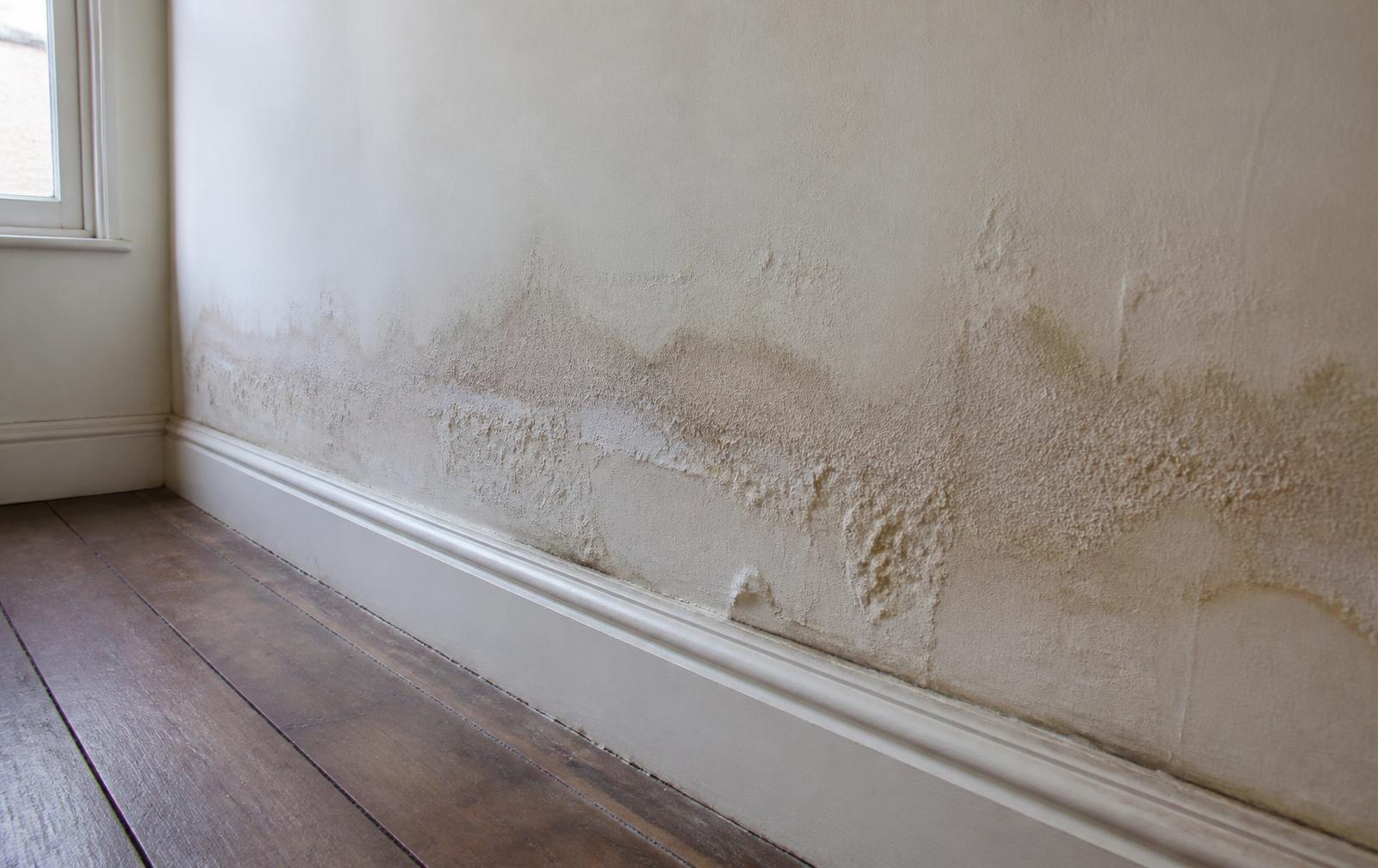
What a failed DPC looks like on a wall
The classic sign is a tidemark: a wavy brown or yellow line across the wall, usually somewhere between 300mm and a metre above the floor. Below it the plaster is damp, stained or crumbling. Above it the wall is dry.
You will often see white, fluffy or crystal deposits on the surface. These are salts carried up from the ground with the water. As the water evaporates, the salts are left in the plaster. They draw moisture out of the air, so the wall can look damp even after the DPC is fixed, which is why the plaster usually has to be replaced too.
Black spotty mould high up on walls, in corners and around windows is not usually rising damp. That is more often condensation, which needs ventilation and condensation control, not a DPC.
What the work involves, start to finish
- Survey. We take readings, look at the outside of the wall and confirm the cause in writing, with a fixed price.
- Preparation. Furniture is moved, floors are protected and skirting boards are removed.
- Hacking off. Salt contaminated plaster is removed, usually to a height of about a metre, or higher if the damp goes further.
- Injection. A row of holes is drilled into the chosen mortar course and the DPC cream is injected.
- Outside works. Any bridging, such as high ground or render below the DPC, is dealt with.
- Replastering with a salt resistant plaster system, then skirting boards refitted.
Typical timescales
The injection itself is quick. The time is mostly in stripping and replastering. A single wall is often done within a day or two. A full ground floor of a terraced house takes longer. We give you a timescale with your written quote.
The wall then needs time to dry out. A rough rule often quoted is about a month for every 25mm of wall thickness, so an old solid wall can take several months to dry fully. You can usually live in the room as normal while it does.
What happens to the plaster afterwards
Original plaster on a wall with rising damp is almost always contaminated with salts, so it has to come off. If it stays, the wall can stay damp even with a working DPC.
We replaster with a renovating or salt resistant system designed to let the wall keep drying out while holding back any remaining salts. Fresh plaster needs to dry before decoration. Use a breathable emulsion for the first coat and avoid vinyl paper until the wall is fully dry. See plastering and dry lining for more.
Guarantees
Guaranteed treatments come with a written guarantee issued in the property owner's name. It transfers to a new owner if you sell, which buyers' surveyors and solicitors will ask about. Keep it with your house documents. Read more on our accreditations and guarantees page.
We work across North Shields, Newcastle, Gateshead, South Shields and the rest of the areas we cover.
Frequently asked questions

Think your damp proof course has failed?
Ring us for a free survey. We will tell you whether it is rising damp or something else, and give you a fixed written price before any work is agreed.